Battery health
What a battery report is, how to read one, and what its percentage tells you about a used electric car or plug-in hybrid. Where a car has a report, its page shows the battery health and the date it was measured.
The report
What a battery report is, and how to read one
A battery stores a little less energy as it ages. A battery report measures how much it holds on a given day and compares that with what it held when new. The sample beside this follows the layout of the reports on this site.
Battery health
The usable capacity today as a share of the capacity when new. It is the figure a car’s page shows, with its date.
Usable capacity
How much energy the battery holds now, in kilowatt-hours.
Battery when new
The manufacturer’s figure for the same battery when the car was new.
Date measured
Battery health is true for that day. Capacity changes slowly with age and use, so a recent date tells you more.
Odometer at test
The miles on the car when the battery was measured.
Measured by · Method
Who measured the battery, and how: with a diagnostic tool connected to the car, or by charging and driving it under set conditions.
Conditions and notes
The second page records how the test was run and the battery warranty as entered for the car.
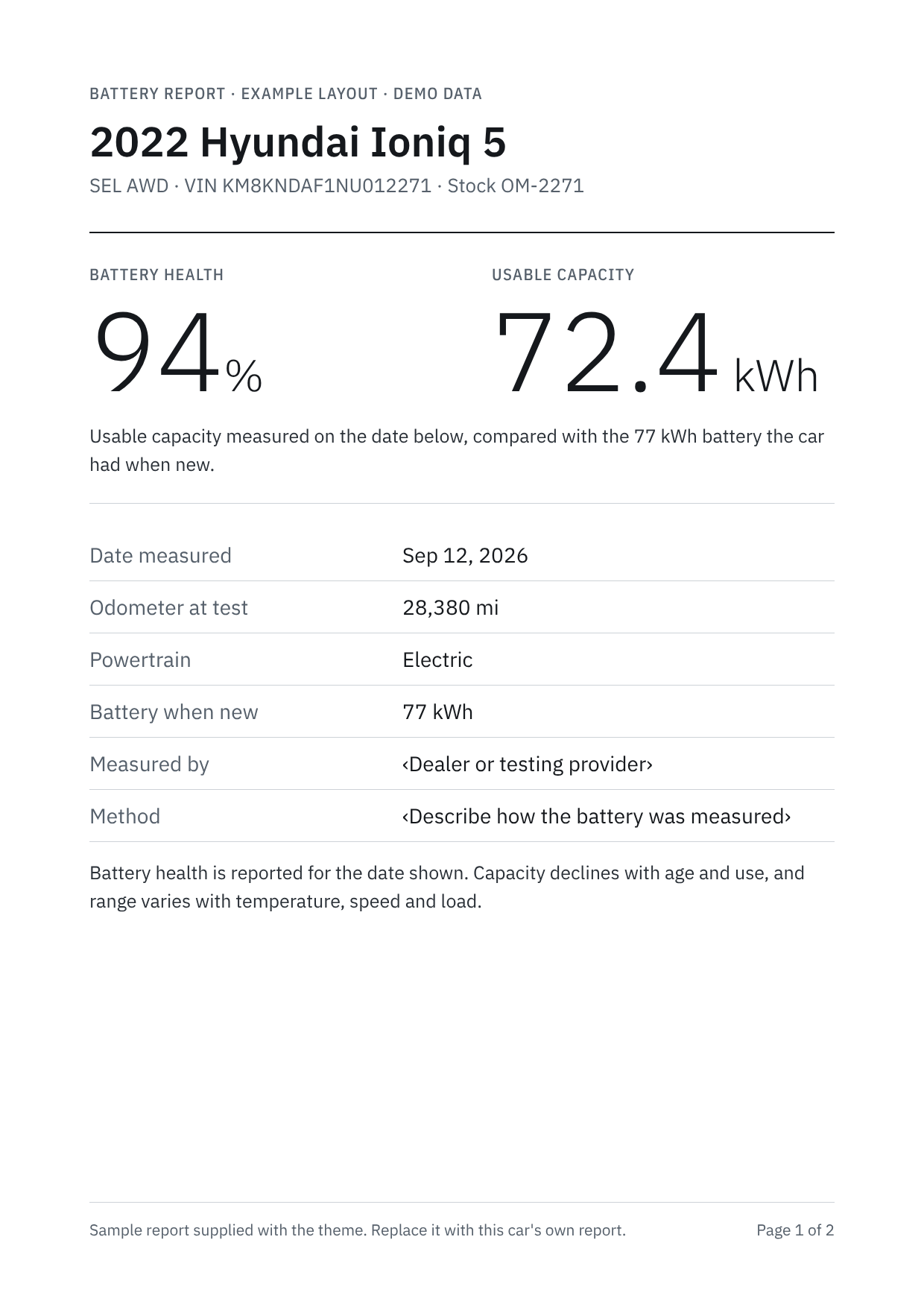
Battery health as reported on the date shown. Capacity declines with age and use.
Sample report in the theme’s example layout, with demo data. A car with a report shows its own on its page.
The percentage
What battery health tells you, and what it doesn’t
It tells you
How much of the battery is left
One number for one day: the battery’s capacity now, beside its capacity when new.
Capacity today
How much energy the battery holds compared with when it was new, on the day it was measured.
Range on a full charge
A battery that holds less goes less far on a full charge than the EPA estimate when new. The car’s page lists that estimate and does not work out a new one.
How two cars compare
Two cars of the same model and battery can be compared by their battery health, when both reports are recent.
It doesn’t tell you
What one number leaves out
A report describes the battery. These depend on other things.
Range on a given day
Range also changes with the temperature, your speed, the load and the use of heat or air conditioning.
The years ahead
How quickly a battery loses capacity varies from car to car. A report describes the battery today, not in the future.
The rest of the car
Battery health says nothing about the motor, the brakes, the tires or the car’s history. The history report and an inspection cover those.
A grade
There is no pass mark. A car’s page shows the number and the date, not a rating.
Questions
What people ask about battery health
What is a good battery health?
It depends on the car’s age, its mileage and the model. Compare a car with others of the same model and year, and ask us to talk you through its report.
How quickly does battery health go down?
For most cars it goes down slowly, often a little faster in the first years and more gradually after that. Heat, frequent fast charging and long spells at a full or empty charge can add to it.
Is the battery covered by a warranty?
Most manufacturers give their electric cars and plug-in hybrids a battery warranty for a set number of years or miles, and some cover a loss of capacity below a stated level. A car’s page lists its battery warranty where one has been entered. Confirm coverage with the manufacturer: it can depend on the car’s age, mileage and history.
Can a battery be repaired or replaced?
Yes. A battery can be repaired, often one section at a time, or replaced, though either is a large job. A recent report is one way to know where a battery stands before you buy.
Why does a car show no battery health?
It has no report yet, or it is a hybrid, whose small battery is not usually measured this way. The page leaves the figure out rather than guess. Ask us whether a report can be done before you buy.
Does battery health change the range on the car’s page?
No. The range on a car’s page is the EPA estimate when the car was new. A battery that holds less goes less far on a full charge than that estimate.
Read the report before you drive.
On a test drive we go through the car’s battery report with you, and answer what it doesn’t.