Charging
How charging works at home and on the road, the four kinds of charge port, and when an adapter helps. Each car’s page names its own port and lists the manufacturer’s charging times.
At home
Most charging happens where the car parks
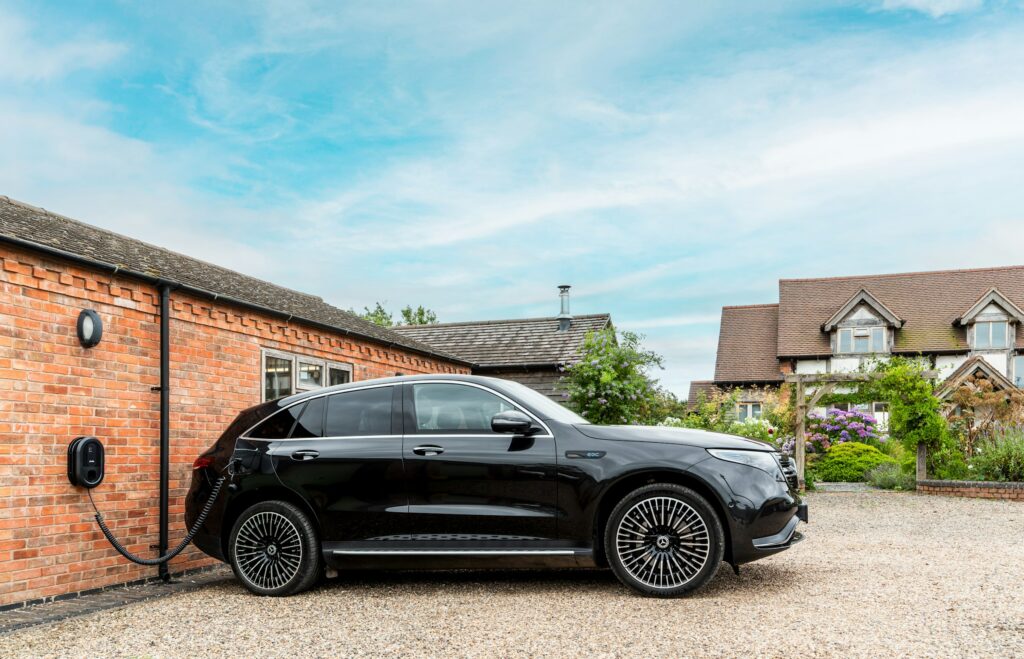
Plugging in at home overnight, the way you charge a phone, covers most daily driving. There are two ways to do it.
Wall outlet · Level 1
An ordinary household outlet and a portable cable, which many cars come with. Nothing to install. Slow, and enough for many daily commutes overnight.
240-volt charger · Level 2
A wall charger on a 240-volt circuit, the kind a clothes dryer uses. Much quicker than an outlet, and the usual way to charge at home.
Installing one
A licensed electrician fits the circuit and the charger, and can tell you whether your electrical panel has room. Some towns ask for a permit.
Plug-in hybrids
Their batteries are smaller, so many charge overnight from a wall outlet.
No driveway?
Chargers at work, in parking garages or at nearby stores can stand in for one at home. A hybrid needs none: it has nothing to plug in.
On the road
Fast charging, for longer trips
DC fast
How a fast charger works
A fast charger feeds power straight to the battery, so it refills much of it while you take a break. Fast chargers are found at stations, not at home.
Where you find them
Along highways, at shopping centers and in some town centers. The car’s navigation and charging apps show where they are.
Paying
Most take a card or an app account. Each station’s operator sets its own prices, often by the energy delivered or by the minute.
Why it slows as it fills
A battery takes charge fastest when it is low, and charging slows as it fills. On a trip, stopping short of full usually saves time.
Which cars can
Most electric cars can fast charge. Most plug-in hybrids cannot, and a hybrid has nothing to plug in. Each car’s page shows whether it can.
Charging times
Each car’s page lists the manufacturer’s estimate for a fast charge. Real times vary with the charger, the temperature and the battery.
Charge ports
Four kinds of charge port
Each car’s page names its own charge port. The port tells you which chargers fit; how quickly a car charges depends on the car.
Adapters
When the plug doesn’t match
An adapter lets a car use a charger built for a different port. Many cars with a CCS1 port can use NACS fast chargers with one, and a car with a NACS port can use J1772 chargers with another. Use only an adapter the carmaker supplies or approves, rated for the kind of charging you plan, and read the car’s manual first. Whether a fast charger accepts a car through an adapter depends on the car, the station and its software, so check before a trip that depends on it. Ask us whether the car comes with one.
Questions
What people ask about charging
How long does it take to charge?
It depends on the car, the charger, the temperature and how full the battery is. Each car’s page lists the manufacturer’s estimates for a fast charge and for a Level 2 charge.
Do I charge it to full?
Many carmakers suggest a daily limit below full, and a full charge before a long trip. The car’s manual says what its maker recommends, and you set the limit in the car or its app.
Is it all right to leave it plugged in?
Yes. The car stops charging when it reaches the limit you set, and many cars can be set to charge at a chosen time, such as overnight.
Can I charge in the rain?
Yes. Charge ports, cables and chargers are built for wet weather. Use a cable that is in good condition, and follow the charger’s instructions.
Can a plug-in hybrid use a fast charger?
Most cannot: they charge at home or on a Level 2 charger. Where a car can fast charge, its page lists a fast-charge time; where it cannot, the page leaves that row out.
Does charging at home add to my electric bill?
Yes, by the electricity the car uses. Some utilities offer lower rates at night or for electric cars; ask yours what it offers.
Try the cable before you buy.
On a test drive we show you the charge port, you plug in and unplug, and we talk through charging at home.